
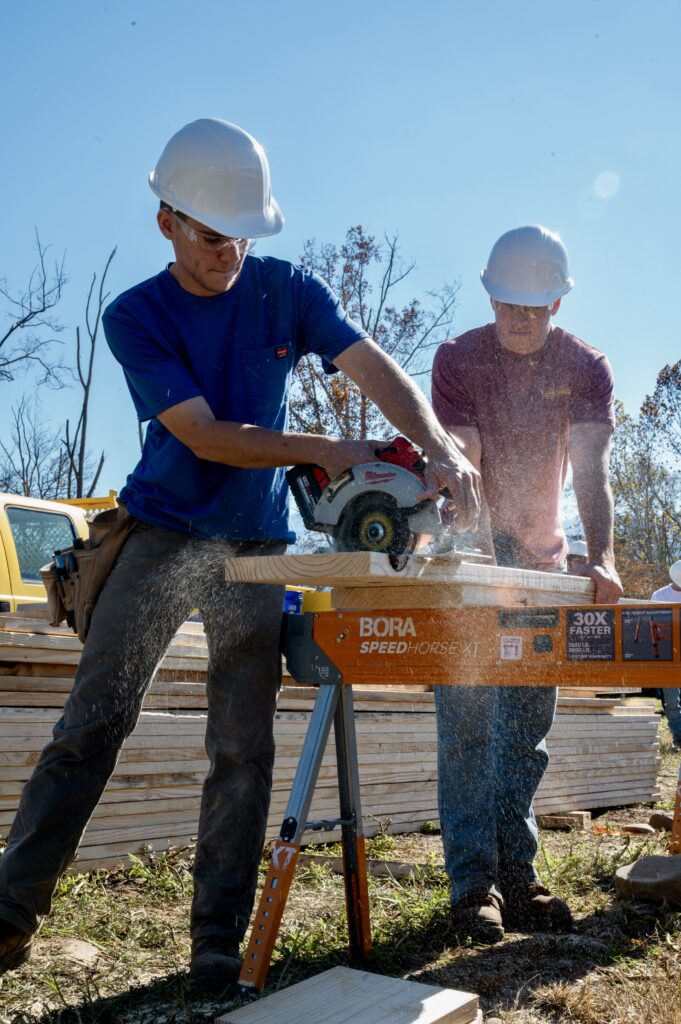
On a 12-acre stretch of donated land in Cherokee County, NC, a new neighborhood is taking shape. Three homes are framed, one is nearly dried in and another is ready for a roof. But a closer look reveals that the site also serves other purposes. This construction site is also a classroom providing training and skills development for youth while tackling one of Western North Carolina’s most urgent challenges: the lack of affordable housing.
“Usually to improve economic development in a community, the focus is on infrastructure, product and workforce,” explained Paul Worley, Tri-County Community College’s (TCCC) vice president of economic and workforce development, “but in our rural community, the issue of housing is a big hindrance in attracting business.”
In considering this challenge, a different way to approach the housing crunch began to emerge: what if the college could help build the housing while simultaneously training the workforce to do it? Today, in partnership with local contractors and the support of a $2.1 million grant from Dogwood Health Trust, the college has launched a comprehensive, hands-on housing initiative that integrates Career & Technical Education (CTE) directly into the construction process.
The result is 17 new and affordable single-family homes in Cherokee County, built by students in collaboration with local contractors. The development will include three-bedroom, two-bath houses, roughly 1,200 to 1,400 square feet, priced between $225,000 and $250,000. To maximize accessibility for working families, Mountain Projects will handle sales and provide financial counseling to buyers. Meanwhile, deed restrictions preserve long-term affordability.
Building a workforce
Aaron Patton, associate vice president for workforce trade at TCCC calls the project a “two-pronged solution” because in addition to addressing affordable housing in Cherokee County, it also supports residents within the region in search of a living wage.
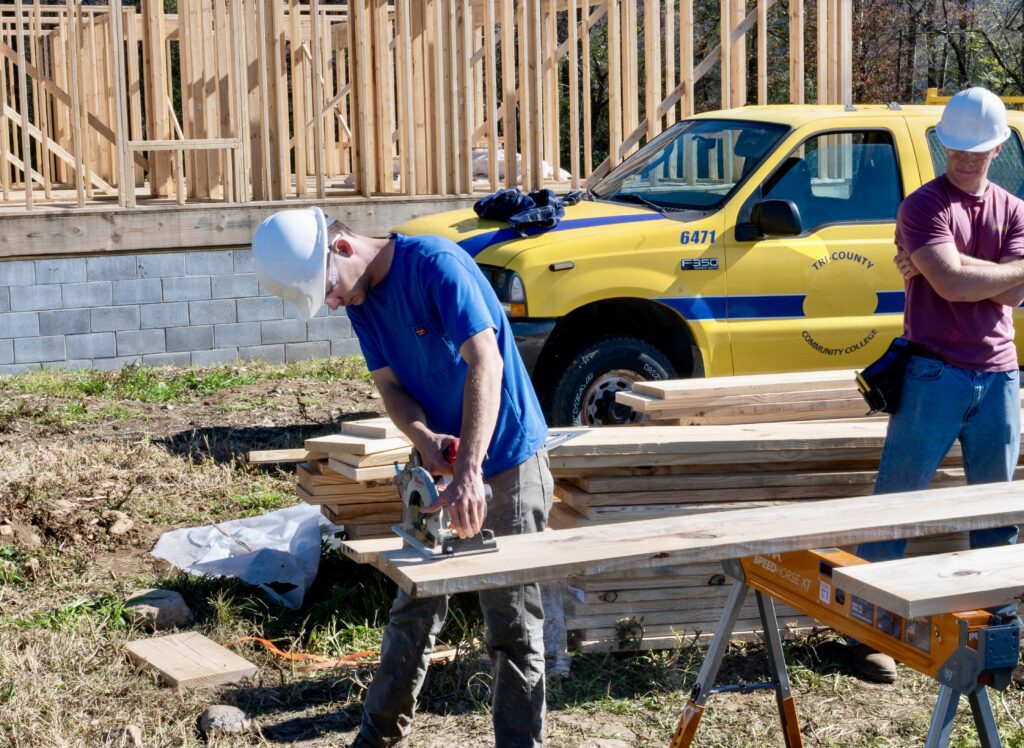
“This isn’t about building 17 houses and walking away — we are building careers. This program comes at a crucial time when you consider the workforce,” Patton said. “A lot of our local tradesmen right now are aging out of the industry. Building this pipeline of young, talented individuals is critical.”
Through TCCC’s program, students can complete short-term credentials in construction, electrical, plumbing, HVAC and heavy equipment programs in a year or less, earning industry-recognized certifications that position them for immediate employment. Many will step directly into jobs that pay $75,000 or more annually, with opportunities to advance or even start their own businesses. Others choose to continue into two-year degree programs, using their credentials to work towards further education.
Learning by doing
Real-world experience is a vital benefit for program participants. On the job site, TCCC students navigate the complexities of construction while coordinating in real time across trades, adapting to delays and solving problems. “In a classroom, you can wire the same wall over and over,” Worley added. “Out here, you’re working around plumbers, HVAC crews and inspectors. That’s real life. That’s what prepares them.”
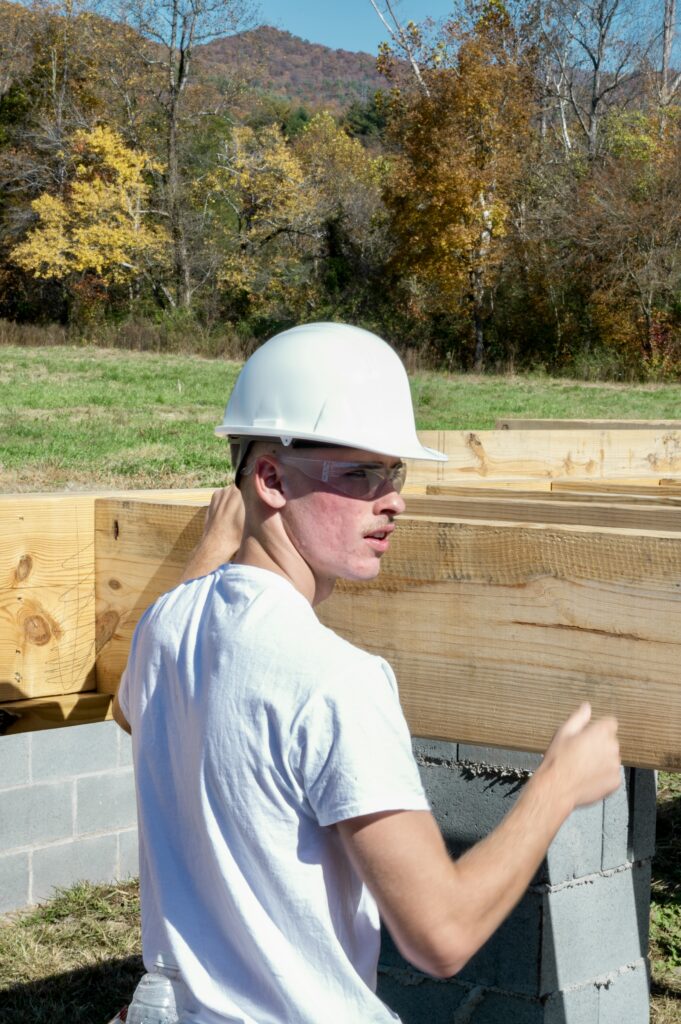
Will Shore is one such student currently in his first year of the program who hopes to ultimately run his own business as a general contractor. “I’m a hands-on learner. I’ve learned 10 times more out here than I ever would have in a classroom,” said Shore. “Come here, and you learn it all, basically. We’ve literally built these houses from the ground up.”
Today, the college is expanding the initiative to bring career pathways to high schools and rural communities across Cherokee, Clay and Graham counties. High school students are now able to explore training in trades such as electrical and HVAC before they graduate, accelerating their pathways into the workforce. “We’re building a pipeline,” Patton said. “If students want to work, they can go to work.”
After completing his studies at TCCC, Shore hopes to do just that as a new professional. “I think I want to stay here in Western North Carolina,” Shore reflected. “You can make a living by doing this right here in the community.”
Looking ahead, the project is being envisioned as a model that will likely continue beyond the initial 17 homes, with a framework developing that could allow for replication in other communities. Patton credits TCCC leaders in supporting the innovative approach and moving the initiative forward.
“People all the time are getting in touch with us wanting to hear more about it. This works because people believe in it,” Worley said. “It’s not just a grant. It’s a community effort.”
