
In McDowell County, like many communities across Western North Carolina, working families know firsthand the challenges that emerge when childcare is hard to come by. When parents can’t secure care, they miss work, turn down opportunities, or leave the workforce entirely, creating ripple effects for families and the economy.
At McDowell Technical Community College, leaders are tackling this problem by investing in the early care and education (ECE) professionals who make childcare possible.
“There’s a childcare crisis in our state, and it’s the same here in McDowell County,” said Katherine Dowdle, director of early childhood education at McDowell Tech. Dowdle and her colleague, Dr. Brandon Hensley, dean of career and technical education, are leading a six-year, $1.7 million dollar program funded by Dogwood Health Trust to strengthen the county’s ECE ecosystem.

Their work is timely. A recent report estimates that North Carolina loses more than $5.65 billion annually in economic activity due to childcare challenges. One survey shows that 60% of parents with young children have missed work because of a problem with childcare, while 37% have refused job opportunities because increased childcare costs would outweigh the benefits.
“The issue comes up very frequently,” noted Dr. Hensley. “There is broad recognition that it is a problem. I think there is agreement that if we could solve the problem, there would be more potential employees available to work.”
Four years into the initiative, the results are clear: enrollment in early childhood education courses is growing, classes are filling, and more qualified educators are entering the workforce. Based on this success, the college has developed a playbook to help other community colleges replicate the model.
Access is everything
For aspiring ECE professionals, McDowell Tech learned that removing barriers within their own classrooms helped boost ECE enrollment numbers. Through Dogwood grant funds, scholarships were provided to offset the costs of tuition and books, opening doors within the program for students, such as first-generation college students, who may have once viewed higher education as financially out of reach.
“This allowed us to look beyond the students that would traditionally show up at our door,” Hensley explained, noting the importance of diversity within the field. “We were able to attract some other groups that had not been as big a part of that program.”
The results have been significant. Enrollment in early childhood education courses has increased by 25% compared to pre-grant levels. “For students, knowing that they can start their career without being in debt is huge,” Dowdle said. “That alone has made our numbers go up significantly.” Scholarship recipient Heather Toney said the opportunity “completely changed” her educational journey. “Because of this support, I have been able to focus fully on my classes, my students, and growing as a teacher instead of worrying about how to pay for school. Professionally, it’s given me the freedom to begin my career feeling confident and financially stable.”
Fast-Tracking the Next Generation of ECE Professionals
While increased enrollment is beginning to strengthen the long-term pipeline of educators, families and businesses often can’t afford to wait. To meet this immediate need, McDowell Tech created Early Childhood Academy, a highly efficient two-week course during which students build a comprehensive employment portfolio with all state-required training certificates and assessments. This advantage enables academy graduates to be immediately eligible for employment.
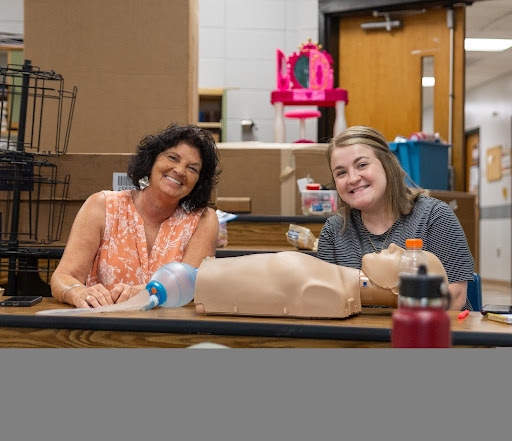
“We want students to be able to go straight into the workforce,” Dowdle remarked. Normally, pulling together the required certifications and paperwork can cost students as much as $450 and take months. The college is now able to cover these costs through the Dogwood grant. “Not only are students getting 64 contact hours for the class in the two weeks’ time, but they’re also getting CPR certification, ITS and SIDS training, playground safety and fire safety training, background checks, fingerprinting, a health assessment and TB test,” she added.
So far, about 60% of students have completed the program, and more than half secure childcare jobs soon after. According to Dowdle, the accelerated model not only fills immediate workforce gaps but also builds confidence. “It shows them, ‘I can do this. This can be a career.’”
Lucia Castillo recently completed the academy and said it made a huge difference in helping her secure employment. “This helped with the hiring process so much,” Castillo said. “They didn’t need much from me because it was all in my notebook. It didn’t take long for me to hear back from the hiring committee that I got the job.”
Supporting Educators and Their Families
While increasing the number of ECE professionals is one goal, improving quality and supporting current educators are also paramount. The Dogwood grant has allowed McDowell Tech to offer free professional development for ECE professionals, with plans for the school to serve as a regional hub for high-quality training for the years to come.
Demand for these opportunities is strong. When local educators shared that they needed more support with classroom behavior management, the college responded by offering a targeted course. “We had well over 100 people show up, and we were able to offer that to them at no cost. Being able to help them with this was huge,” said Dowdle.
The college also recognized that many aspiring and current ECE professionals are parents themselves and need childcare too. The college’s Child Development Center provides on-campus childcare, helping students who balance the demands of home, school and career. The college was able to expand the center’s operating hours to evenings, allowing parents to attend classes after the traditional workday concludes.

Beyond providing care, the center also serves as a training ground for students and a demonstration classroom where educators observe effective practices in action. Partnerships with community partners have also led to practical innovations, such as a lending library of licensing and classroom materials available for checkout to childcare centers across the county. Meanwhile, the college continues to invest in training its own childcare staff and ECE faculty, which strengthens workforce retention and ensures that team members offer high-quality programs and practices.
With several years of learning and discovery behind them, and a playbook now available to share with other communities, Hensley says the future looks bright. The program’s continued momentum and demonstrated results offer promising lessons for strengthening the ECE workforce and supporting the families and businesses that depend on it.
