
The historic $26 billion national opioid settlement agreement is bringing millions to communities that experienced the devastating effects of opioid misuse and addiction. Many towns and counties that joined the litigation nationwide are just beginning to figure out the best ways to put those dollars to work. However, thanks to an early investment in collaborative planning from Dogwood Health Trust, communities in Western North Carolina (WNC) have the advantage of a running start.
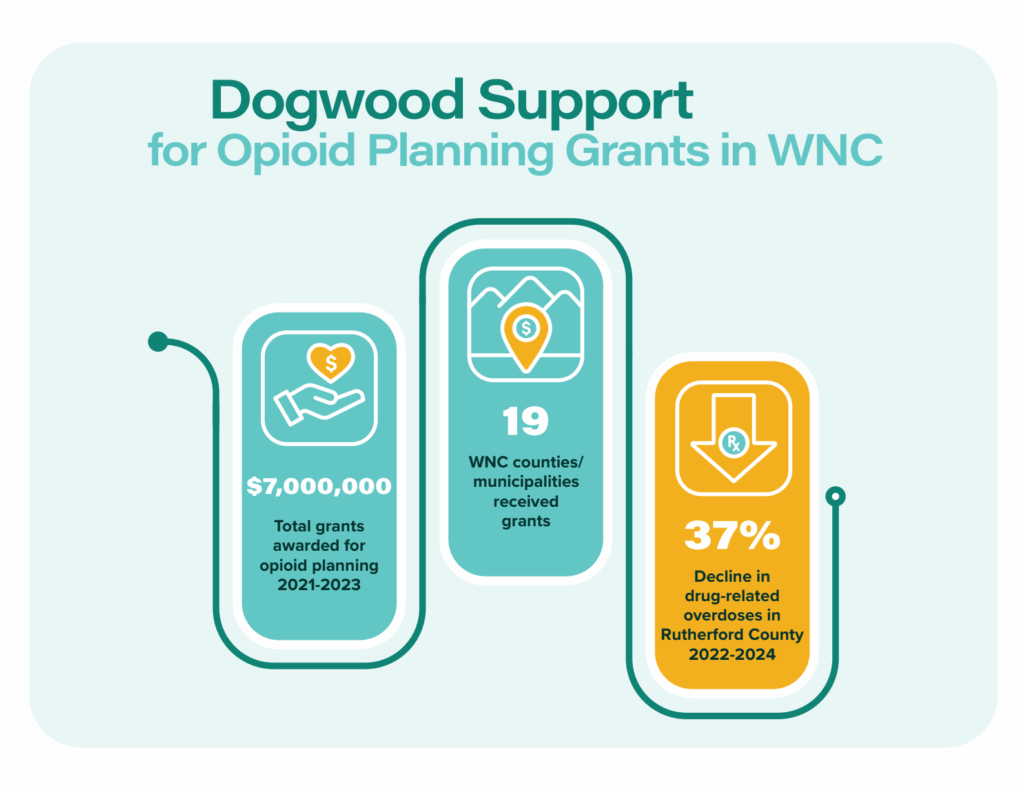
From 2021 through 2023, Dogwood awarded a total of $7,010,030 in planning grants to 19 WNC counties and municipalities. The grants of up to $600,000 each, aligned community members across sectors to strategize solutions in advance of the distribution of settlement dollars. Extensive collaborative planning also enabled grantees to tap into more sophisticated programs offered through the agreement.
“We’ve seen press on a national level about counties that rushed into spending funds too quickly, but we’ve been able to plan in a different way,” explained Rutherford County Manager Steve Garrison. “We’re heading down a path that allows for programs that do more for long-term recovery, while also addressing community education and stigma.”
Complex problems, complex solutions
Across Western North Carolina, the need for recovery is acute. In Rutherford County, overdose deaths declined in 2024, but data from the NC Department of Health and Human Services still ranks the county among the highest opioid overdose emergency department visit rates — more than double the statewide average. Garrison, along with a committed strategic planning team, is determined to reverse this trend.
Rutherford County aimed their grant squarely at boosting collaboration with community partners and then educating decision makers about strategies that work. Steeped in both data and community feedback, the results have been illuminating and clarifying, said Scott Luetgenau, Founder and Lead Consultant of Gatespring, who was tapped by Rutherford County to lead the planning process.
“There was a need for experience with data collection to suss out the needs of the community. We also listened to people whose voices usually aren’t heard and who aren’t typically at the table — like those still using substances,” Luetgenau said. “This helped us to be effective in not only preventing — but treating — opioid use disorders. There are evidence-based practices around each point of the continuum, but we want the best bang for the buck.”
Luetgenau engaged in more than 75 community interviews with individuals in fields spanning from health care and law enforcement to local nonprofit partners and people with lived experience. Before long, common themes emerged in conversation, like an urgent need for pre- and post-incarceration recovery support. Transportation and housing were also often named as persistent barriers to recovery, in addition to stigma around addiction, and partners that were doing excellent work – but sometimes working in silos.
“We used part of the Dogwood planning grant to publish a report to help the county better understand what evidence-based treatment looks like for opioid use disorders,” Luetgenau noted. “It gave us a runway to plan in a way that wasn’t going to squander the dollars.”
Planning for the future
Two pathways exist for local governments in North Carolina to access opioid settlement funds. The simpler and more direct Option A provides access to a limited, evidence-based list of 12 “high-impact” strategies, while the more flexible Option B offers more than 100 remediation strategies. However, Option B requires an extensive collaborative strategic planning process with a wide array of local stakeholders.
The support of the Dogwood grant helped enable Rutherford County to check the box for Option B, ultimately unlocking programs that cater more specifically and with greater nuance to local identified needs, Luetgenau said. “We’ve learned how to thread the needle and spend these funds in a way that is acceptable by the MOA, and that also scratches the itches of what Rutherford really needs.”
One-third of the county’s 15 recommended strategies that have been formally accepted by the county commissioners come from Option B. These include life-sustaining buprenorphine inductions in hospital emergency rooms, transportation supports for access to clinics, court, jobs, and recovery resources; enhanced supports for children and families experiencing trauma; stigma reduction initiatives as well as increased education around Good Samaritan laws to increase calls to 911 to report overdose and help reduce fatalities.
While the path forward will not be without challenges such as health care access in a rural county and aligning public perception with evidence-based practices, Garrison has hope and optimism for a future of recovery. “Going through this process highlighted areas and gaps that I don’t think we could have fully understood otherwise,” he reflected. “It is giving us an opportunity to pull together, communicate, compare notes and work toward the same goal.”
