
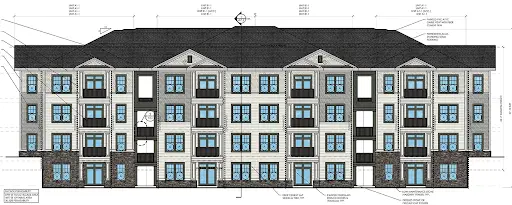
Haywood County residents in search of local, affordable housing options are now one step closer to coming home, thanks to a multi-pronged, collaborative effort helping Mountain Housing Opportunities (MHO) bring the 84-unit, $25.7 million Balsam Edge development to fruition. The highly walkable community of 1-, 2- and 3-bedroom apartments in Waynesville, NC, will serve renters who earn between 40% and 60% of the Area Median Income.
“Knowing 84 families soon won’t have the stress of parting with half of their paycheck or more towards housing costs, that’s absolutely why we do it,” reflected Geoffrey Barton, Mountain Housing Opportunities president and CEO. “It’s the most rewarding thing when we ultimately finish and help residents move in. That’s the joy of the job.”
On the heels of Hurricane Helene — and recognizing the overarching need for affordable housing in the region — Dogwood Health Trust provided an inaugural investment of $40 million in February 2025 to Self-Help Ventures Fund, through Self-Help Credit Union. This enabled the launch of the WNC Affordable Housing Loan Fund, with a goal of expanding housing options for people earning 80 percent or less of the Area Median Income. Balsam Edge is one of the Affordable Housing Loan Fund’s first projects to progress through the pipeline to final closing, with groundbreaking soon to follow.

Bringing It Home
The need for affordable housing in Western North Carolina is longstanding and widely known. Dogwood’s comprehensive 2021 Housing Needs Assessment of Western North Carolina found that the region would likely need nearly 13,500 more units of affordable rental housing and just over 3,000 more units of affordable for-sale housing by 2025 to satisfy growing demand. The devastating impact of Hurricane Helene on the region’s affordable housing inventory has only intensified the need.
In a more recent 2024 survey conducted by WNC Health Network, 43 percent of Haywood County residents expressed concerns about their ability to pay for monthly housing costs. This statistic is congruent with the rising number of “cost-burdened” WNC residents spending more than 30 percent of household income on housing costs.
Nonprofit and for-profit developers of affordable housing projects can use the WNC Affordable Housing Loan Fund to make ends meet and maintain project momentum in the growing complexities of today’s market, especially in rural communities traditionally lacking the housing investment programs necessary to maximize the low-income housing tax credit program. Dogwood’s investment is expected to leverage an estimated $150 million from other sources and create or preserve a projected 1,000 units of affordable housing in the region.
Timing Is Everything
While Barton’s team, along with community and government partners in Waynesville is planning to celebrate a spring 2026 groundbreaking for construction of Balsam Edge, the journey to this milestone has been a long one. The five-acre site was first identified by MHO in 2020. In 2021, Dogwood awarded MHO a $855,000 grant for the site’s purchase, and in 2025, the final layer of financing was made possible through the WNC Affordable Housing Loan Fund.
MHO Real Estate Developer Justin Tuttle said the influence of unusual external factors between financing and groundbreaking caused the economy to evolve much faster than the project could evolve. Circumstances such as the COVID-19 pandemic and Hurricane Helene significantly affected the costs of materials and services — all factors that contributed to an approximate $7 million financing gap for Balsam Edge.
“It can become a perpetuating cycle of not having enough money, going to ask for more money and then by the time you get that additional money, costs go up again,” said Tuttle. “Dogwood and the Western North Carolina Affordable Housing Loan Fund came in to make this deal feasible and fill that gap.”
Today the Fund supports multiple projects, expanding options for residents in the region who need affordable housing the most. Construction began in early 2026, and Balsam Edge is tentatively slated to open in the winter of 2027. Meanwhile, MHO is gaining momentum on four additional construction sites in WNC, comprising 264 affordable rental units and 60 for-sale homes, with several hundred more in pre-development and planning.
“Dogwood’s participation in this project at the front end, helping us buy the site was catalytic, and then on the back end, having the Affordable Housing Loan Fund step in, this was the difference maker that really led to viability,” Barton added. “If the Fund didn’t exist, this project wouldn’t be happening. The fact that we can finally deliver — we’re really excited about that.”
